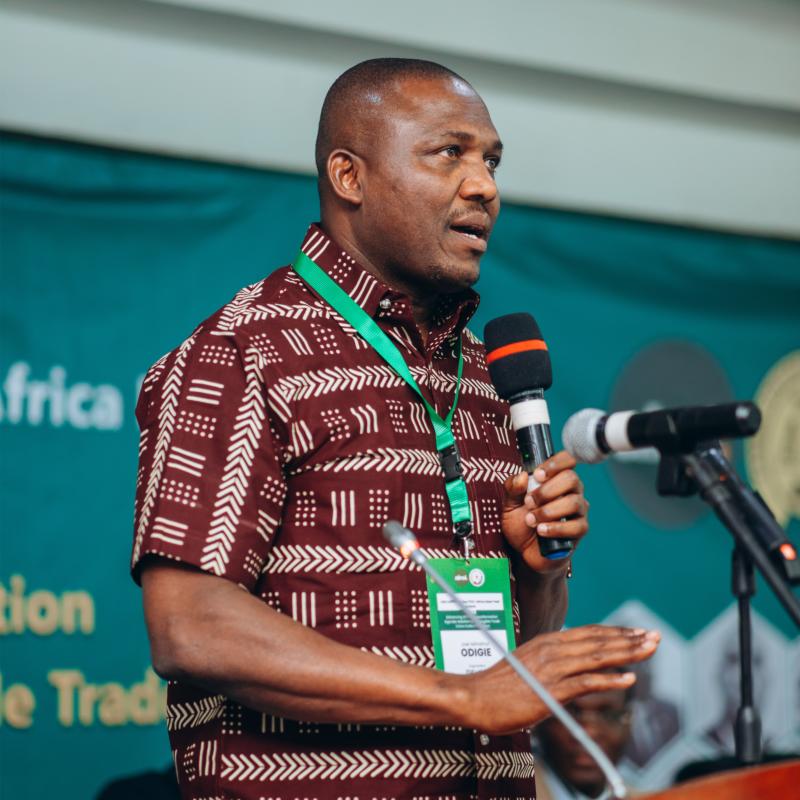
Joel Odigie is General Secretary of the African Regional Organisation of the International Trade Union Confederation, ITUC-Africa. ITUC-Africs represents 18 million working men and women in 52 of the 54 UN-recognised African states, and is are based in Lomé, Togo.
Question: How is the current geopolitical context affecting African workers, and is it helping the EU move beyond post-colonial dynamics?
The African continent is often seen as the “problem child” of development, or as the symbol of poverty and misery. Even as the continent tries to get out of this framing, it is beaten down by global wealth arrangements that lead to wealth going out of Africa rather than coming in. The narrative is that Africa is a debtor continent. But when you juxtapose that with illicit financial flows leaving Africa for decades, even close to centuries, you realise that Africa should in fact be a creditor continent.
Unfortunately, the current context is reinforcing structural imbalances. What I would have wished to see is a moment to reconstruct the relationship with Africa. But Europe is beginning to shed some of its identity as a rights-based partner and is trying to drive competition in the way the Chinese model would: rules, rights and so on are less important; just get the business done.
That is always a crisis for workers, working women, young people and vulnerable workers, the majority of whom are in the informal economy. They find themselves within a competition that treats them as commodities. That is contrary to our position as trade unions: workers are not commodities. In this context, these realities reinforce generational poverty and the feminisation of poverty, where poverty is more likely to have the face of a woman or a girl child than ever before.
Question: What kinds of ODA and investments are useful and development-responsive for workers, young people and women in Africa?
This question is key to our development challenge. First, we are concerned about cuts in overseas development assistance. We are also concerned about the sectors towards which funding is being shifted. ODA should go into education, health care, sanitation, potable water and social protection — creating enabling safety nets.
The story of Europe’s development paradigm is also a story of strong safety nets. Those safety nets are largely non-existent on our continent. It cannot be financed while illicit financial flows continue to haemorrhage the continent of critical resources. It cannot be financed when debt-servicing arrangements are unbearable: some countries spend 40% of national revenue on debt servicing, some 50%, and some far more. This is unsustainable.
We want to see partnerships in education and skills development. People need the skills to support themselves and put their hands to work. Jobs and employment are at the heart of human dignity. Nobody loves handouts. People want to work to earn their keep, and they must be supported and given the opportunity to do so.
Public service delivery is essential. Europe grew on the back of welfare states. The role of the public sector and the role of the state cannot automatically be replaced by the private sector. There is a role for the private sector — no dispute — but the state must continue to thrive, especially in African societies.
We want investment that helps close poverty gaps through employment, skills and social goods. We do not want social investment to be treated as non-bankable or unattractive. If that remains the emphasis, the asymmetry in our relationship will continue to widen. An example is the current EU Global Gateway, which Africa, as a partner, cannot fully be proud of.
When money is not going to defense, it is going to climate change or just transition. But who benefits from this just transition? It goes to European businesses and the private sector.
Question: How should EU responses to competition from China and other actors be assessed from a worker’s perspective?
It is not that initiatives from Europe have not worked. Some initiatives from Germany, the Scandinavian countries and Belgium showed intentions that, if sustained, expanded and made inclusive, could do well. This would be better than shifting to a competitive arrangement where Europe wants to “take” on certain terms and only look at the bottom line.
We do not envy the Chinese model. It is not about who invests on the continent. It is about the nature of the investment: whether it creates decent work, respects labour standards, rights and wellbeing. Jobs are important, but jobs must be decent. Europe has a culture of respect for human rights. You cannot bring your investment to Africa and say: we will keep human rights at the point of exit, and when we arrive we will do things the way others do. We say the same to the Chinese and others: if your investment model does not support rights, leave it at the point of entry. When you come here, there are rights and they must be respected.
Question: What determines whether the energy transition becomes an opportunity for transformation, rather than another cycle of extraction?
Africa is home to important minerals labelled “critical”. But that label is not about minerals being critical for African development. It is about minerals being critical for advancing the development of others. Africa is not home to the absolute majority of critical minerals in the world. But Africa is the place where extractivism is easiest: where you can grab, take and go, often without concern for environmental or labour issues. That is why Africa has been projected as the home of critical minerals.
Look at cobalt and copper and their usefulness in smartphone production. What has that done for countries like the DRC? Child labour in the mines is unprecedented. There is degradation and pollution of water. Look at bauxite in Guinea, or northern Nigeria, where some people say conflict and extremism are used as a disguise to steal mineral wealth and take it away.
How can we have an arrangement where these minerals become an opportunity to construct development relationships? How can we add value on the continent? How can we stop exporting jobs through raw mineral exports and instead build value, jobs and skills locally? Partners should support technology, skills and responsible mining so both parties win.
If the EU really wants to consider this, there is an African Mining Vision, developed by the African Union. It says Africa’s mineral and material wealth must be used to drive beneficiation — adding value and using it to drive manufacturing and industrialisation in a sustainable manner. We are not saying “Africa’s minerals for Africa only”. We are saying: if this is an opportunity, how do we come to an arrangement where both parties benefit?
Question: What are the obstacles to safe and legal mobility, and how should Europe understand migration?
Between Africa and the EU, we see more and more visa restrictions. Within Africa too, we need to challenge over-reliance on colonial borders. Skills need to move, people need to move, goods need to move, ideas need to move, human capital needs to move. In Europe, migration and visa arrangements often demean Africans. Impossible demands and criteria are established to keep people at home, while money is given to other countries, especially in North Africa, to externalise borders.
Europe is an ageing continent and Africa is a youthful one. There is a case for skills-development partnerships, but not agreements where Africa’s best and finest, already trained, are attracted and extracted. How do we work together to train more people through skills-development partnerships for Africa? Then, where there are opportunities for people to live and work in Europe, they should come with good integration arrangements.
People will continue to move. We need arrangements that support mobility, not arrangements that criminalise and dehumanise people. Migration should remain a choice. It should not be closed or unnecessarily restricted. Tightening visa regimes will not solve it. Externalising borders and criminalising migration will not help. For those already in Europe, regularisation should also be part of the process. Spain’s initiative is welcome; we hope it succeeds.
Question: What would make the next EU budget credible and fair from the perspective of African workers?
I would focus on partnerships that address our structural issues. Can we have partnerships and investment in social infrastructure? Can we have investment opportunities that encourage African local production and industrialisation capacity? We sometimes see Africa being kept perpetually as a market, where everything else can be dumped. How do we ensure that labour standards are respected, and protect rights at work for men and women as civic space and civil liberties shrink?
Can we look towards more collaborative and inclusive decision-making? The Global Gateway was designed exclusively as an EU initiative. If it is an initiative to engage with Africa, it would have been better to involve Africa at the point of conception. I was in a meeting in Kenya where an EU official said: this initiative is funded by our money, and we put our mouth where our money is. I found that approach revealing — not just what he said, but the mindset behind it. Since then, when forums call me to engage, I often prefer to stay away rather than be a voice used to legitimise what they already want to do.
Can we have inclusive, collaborative, shared ownership, co-created possibilities? Can we have more support for trade unions and civil society to be players in development implementation and policy formulation? In some cases, we are consulted. In most cases, we are not. And when we are consulted, we are told at the end that trade unions and civil society are non-state actors, while the real clients are governments. If partnership gives voice and visibility to non-state actors in implementation, oversight and delivery, that would be welcome.