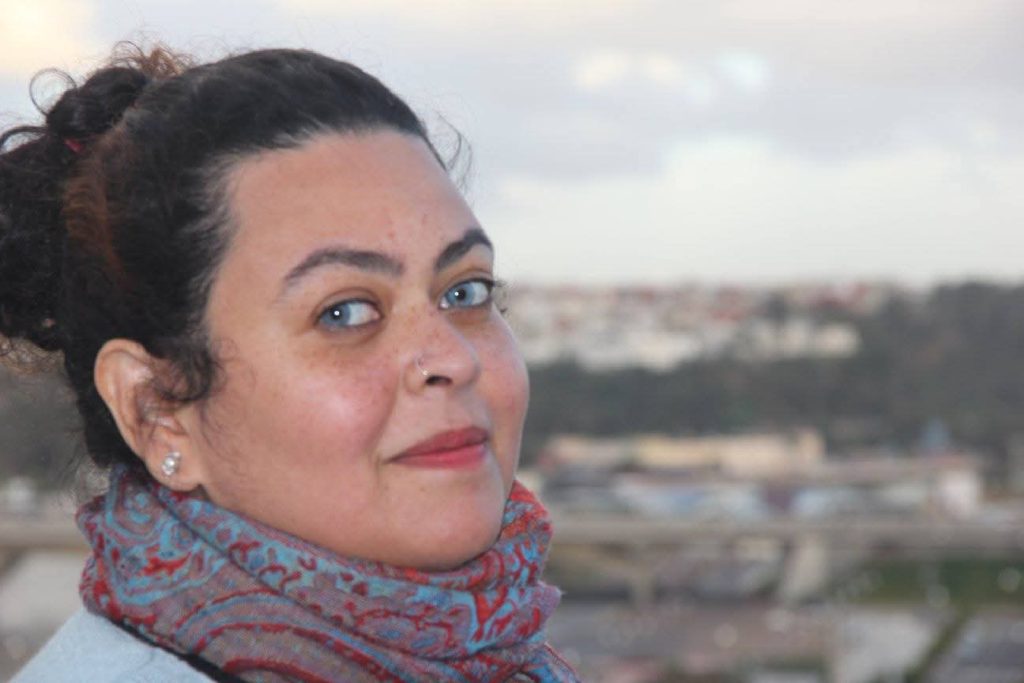
Shereen Talaat is the founder and Executive Director of the MENAFem Movement for Economic Development and Ecological Justice. She’s Egyptian, but based in Morocco.
Q: How is the current geopolitical context affecting marginalized communities in the MENA region, and where does the EU sit in these dynamics?
The current global context is shaped by unequal powers. For communities in the region, this is not just a word or an abstract concept: you see it clearly in debt, austerity measures, trade rules, migration control deals, energy deals, war, militarization, and definitely in the shrinking of public spending. That also leads to negative impacts on democratic space inside our countries.
In this landscape, the EU is a very powerful actor. It often presents itself as value-based, but from the ground you can see that the relationships look unequal. The EU speaks a lot about partnership while prioritizing competitiveness. For example, if we look at the EU Global Gateway strategy, it was crafted from the beginning without Global South partners. This is not a partnership – the EU is contradicting itself.
Speaking about partnership while prioritizing competitiveness, security, border control, access to resources creates many problems, especially when competitiveness and market-based value become the main framework. This leaves no place for care, public services disappear, community needs disappear. Women workers, migrants, rural communities, informal workers carry the strongest impacts of these trends. A fair relationship must begin by addressing power extraction and historical responsibility of colonialization, and the impacts they have nowadays.
Q: What kinds of investments or public spending make the biggest difference in the lives of communities, especially for women and girls and marginalized groups?
The investments that change people’s lives are clear: public sectors like health, education, social protection, food systems, care systems, local productions, community-led climate adaptations, decent work, public transport. These sectors manage the lifeline of people; they reduce inequalities and support marginalized groups and communities during crisis.
But these sectors are often underfunded because they are not seen as bankable. International financing trends are moving in the wrong direction because the paradigm for this global economic architecture relies on liberal capitalism. All that matters are markets and private investments, driving the focus to blended finance and large infrastructure projects. These tools attract capital, but they don’t serve the people.
When public services are cut or underfunded, this has direct consequences on women and girls – who already carry the heavy weight of informal and unpaid care work, which goes unrecognized by institutions. This limits women’s education, paid work, and political participation.
Q: What has been the impact of ODA cuts in the region? How do new financing approaches impact local communities—and who gets to shape how they are designed?
ODA cuts affect civil society directly. You can see how they are impacting feminist movements around the region: women rights organizations, feminist organizations, climate justice groups, small community organizations don’t have access to large funding system.
But the problem is not only the amount, it’s also the quality. Funding is increasingly shaped by donors’ priorities like migration management or private sector mobilization and geopolitical interests. This changes what gets funded and who gets to make those decisions. Many feminist and community organizations are pushed into short-term project, heavy reporting system and donor-driven agendas. This is not movement building at all.
The new financing approaches prioritize bankable projects, while health, education, care, protection from violence, legal support or grassroot organizing are de-prioritized. This also limits the role of civil society to being consulted after decisions are already made. This is not partnership or ownership. Real participation means communities and movements shape priorities, design programs, and implement together.
Q: What determines whether the energy transition becomes an opportunity for transformation, rather than another cycle of extraction?
The climate finance issue raises many different questions and concerns. The large share comes as loans, and that means countries already facing debt pressure are asked to borrow more to respond to a crisis they didn’t create. This is not justice; this is debt expansion.
When it comes to energy transition, we cannot speak about transition from the energy perspective only, especially in countries in the MENA region that are heavily in debt. Our countries are pushed to invest in fossil fuels to be able to pay their debt and their debt services. We have to think about it from a justice perspective: who has historical responsibility? Who needs to phase out? Definitely not us, but the Global North.
Energy transition can be transformative, but only if it breaks the colonial cycle of extraction and the historical responsibility for climate change. The MENA region has major renewable energy potential, but potential doesn’t guarantee justice. The key questions are: who controls the value chain? Who owns the infrastructure? Who gets the job? Who decided where the energy goes? Who benefits from the profits? A just transition must prioritize local needs, debt restructuring and cancellation. In short, it must not reproduce colonial patterns with a green label.
Q: As the EU prepares its next long-term budget, what would a genuinely fair and credible partnership look like from your perspective? And what would be the clearest sign that things are actually changing?
A credible partnership must start with equal power. That means that the EU must stop defining priorities alone and share decision making with civil society, feminist movements, workers, youth, right holders, migrants – basically the right holders and target groups. The priorities should be clear and based on local needs: they must prioritize care system, local food sovereignty, local value creation, democratic accountability, ecological justice, human rights.
The clearest sign of change would be a shift away from extractive deals. Not a better or softer branding but a real shift. For a true partnership to work, the EU would stop using development cooperation to secure resources or control migration or open markets for European companies. It would support the public system and recognize responsibility for its historical deeds, at least on climate. It needs to accept accountability for the social and environmental impacts of its policies. It would support a democratic space even when civil society criticizes some of the EU policies.
Q: MENAFem’s vision is to push for a new global economic system based on intersectional feminist principles, human rights, and ecological justice driven by the needs of communities and the marginalized. What are the key paths we should all walk together to achieve that future – and what role should (or shouldn’t) the EU play in that?
I encourage you to look at MENAFem Movement’s Rabat Declaration and Roadmap: An action agenda for collective advocacy, stemming for a gathering of feminist and allied groups in Rabat, Morocco, around the issues of economic and ecological justice, from a perspective that is anti-colonial, anti-imperial and feminist.
The path forward definitely requires several shifts. We need to move from debt to reparative finance, from austerity to public services, from extraction to sovereignty over our resources, from militarization to care, and from superficial consultations to a real decision-making power for civil society.
The EU can play a big role but only if it’s willing to change its position in the global system. It should not lead from the above. It should not use feminist language while funding border violence, extractive energy projects, and austerity linked to reforms. It should provide predictable grant-based finance and protect policy spaces. It should address tax abuse, debt injustice, climate responsibility and its historical responsibility on the climate crime that we are suffering from now. The future we want will not come from technical fixes alone. The EU should support the priorities defined by communities and movements and be aligned with its public narrative – which is not what is currently really happening on the ground. Only then will we be able to speak of a real shit, and that is the real test of partnership.